
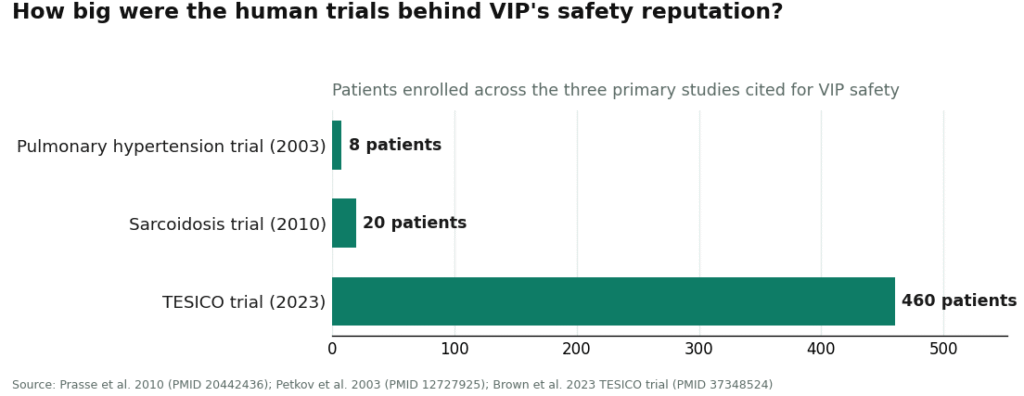
Here’s the number I keep coming back to: twenty. That’s how many people were in the sarcoidosis trial that gives VIP most of its safety reputation. Eight is the other number, from the pulmonary hypertension study. And then there’s 460, the size of the trial that tested VIP’s synthetic cousin during COVID-19. Three studies, three very different scales, and somehow all three get cited in the same breath when people ask “is VIP safe?” I don’t think that’s dishonest, exactly. But I think it flattens something worth unflattening.
A caveat before I get going: I’m not a clinician, I’m someone who reads trial data for a living and tries to explain it plainly. VIP sold for wellness purposes is a compounded, prescription medication, not an FDA-approved product. Talk to a licensed provider before you touch any of this.
What the molecule is actually built to do
Start with the mechanism, because it explains almost every side effect you’ll read about later, and it saves us from treating this as a mystery box.
VIP stands for vasoactive intestinal peptide. “Vasoactive” means it acts on blood vessels, and specifically it relaxes them, a process called vasodilation. Your body already makes VIP and uses it constantly, in your gut, lungs, brain, and nervous system, to relax vessels, prompt glands to secrete, pass signals between nerve cells, and dampen inflammation. That last one is why the wellness crowd is interested in it.
Here’s the logic I find clarifying: if a compound’s core job is widening blood vessels, its side effects will mostly be what happens when blood vessels widen. Not a surprise, not a red flag on its own. Just physics doing what physics does, sometimes more enthusiastically than you’d like.
The numbers behind “well tolerated”
Let’s go back to those sample sizes, because I think they’re the real story here, more than any single side effect.
In the 2010 phase II sarcoidosis trial published in the American Journal of Respiratory and Critical Care Medicine, twenty patients inhaled nebulized VIP for four weeks. It was reported safe and well tolerated, and it measurably calmed lung inflammation (PMID 20442436). In the 2003 pulmonary hypertension study in the Journal of Clinical Investigation, eight patients inhaled VIP, tolerated it well, and saw their pulmonary artery pressure improve (PMID 12727925).
Read those again. Twenty people. Eight people. Four weeks. A single dose, inhaled, under constant clinical supervision. That’s the entire evidentiary basis for “VIP is well tolerated,” and it’s a real basis, not nothing. But it’s a small basis, and small numbers deserve a little humility attached to them.
Now the side effects that actually show up, none of which should surprise you once you’ve internalized the vasodilation point:
Flushing. More blood near the skin’s surface, especially the face, produces warmth and redness. It’s the single most characteristic VIP effect and it’s a direct, mechanical consequence of the vessels widening.
Low blood pressure and lightheadedness. This is the one I’d actually worry about. Relaxed vessels mean lower pressure, and lower pressure can mean dizziness or a brief faint, particularly on standing up fast. Fine for most healthy people in small doses. Less fine if you already run low, or you’re on medication that lowers blood pressure too. Two things pulling the same direction can add up faster than either alone.
Nasal irritation. Since most VIP sold for wellness comes as an intranasal spray, some people get the ordinary irritation, stuffiness, or discomfort of putting anything up the nose. Unremarkable, and not a sign anything unusual is happening.
The counterpoint: 460 is not the same kind of number as 20
Here’s where I want to push back on my own framing number, because it would be too easy to just say “small studies, buyer beware” and move on.
There’s a fourth number worth putting next to the other three: 460. That’s roughly how many patients were enrolled in TESICO, a randomized, placebo-controlled trial of intravenous aviptadil, synthetic VIP, tested against COVID-19-associated respiratory failure and published in The Lancet Respiratory Medicine in 2023 (PMID 37348524). It didn’t work, the trial was stopped for futility. But notice what that number tells you that the 20 and the 8 don’t: this molecule has been taken seriously enough, at high enough intravenous doses, to run a trial ten times larger than the others combined. That’s not the profile of some harmless herbal extract. It’s a real pharmacological agent that researchers thought worth testing at scale, on sick patients, with a data safety monitoring structure behind it.
So the counterpoint to “the safety data is thin” is “the compound has also been through a genuinely large, serious trial, and it didn’t produce alarming safety signals there either, it just didn’t help.” Both things are true at once. That’s the honest picture: reassuring in aggregate, thin in the specific dosing and route and duration that most people buying VIP online are actually going to use.
Why the sample size still matters more than the reassurance
Here’s my synthesis of those two pulls. A study reporting “well tolerated” is answering a narrow question: in this many people, at this dose, by this route, over this many weeks, under this much supervision, did anything bad happen? Twenty people for four weeks, inhaled, in a clinic, is a small, specific answer. It is not the same question as “is it safe for one unsupervised person to spray an unverified concentration up their nose, daily, for a year, with nobody checking their blood pressure.” Nobody has run that trial. The math simply doesn’t stretch that far, no matter how many times the phrase “well tolerated” gets repeated in a forum post.
There’s a second gap worth naming honestly. The trials used VIP made properly, dosed deliberately, administered in a clinic. A lot of VIP sold online is a “research chemical” shipped in a vial stamped “not for human consumption,” with no clinician, no licensed pharmacy, and whatever purity the seller felt like providing. So you’re not just extrapolating past what twenty or eight patients showed. You’re doing it with a product that may not contain what the label claims, at a strength nobody verified. The clean trial data doesn’t travel with the vial. I wish it did.
Who should think twice
A few groups where the arithmetic above should carry extra weight:
If you have blood pressure issues, or take blood pressure medication. VIP lowers blood pressure. So do a lot of prescriptions. Stack them and you can end up lower than either alone would put you. Get a clinician who knows your full medication list involved first.
If you have a heart condition. Anything acting meaningfully on vessels and pressure belongs in front of a cardiologist, not a forum thread.
If you’re pregnant, trying to conceive, or breastfeeding. The data here just doesn’t exist. Read “unknown” as “don’t, without medical guidance,” not as “probably harmless.”
If you’re on several other medications. VIP’s interactions aren’t well mapped. The more you’re already taking, the more a qualified person should look at the whole picture before you add one more variable.
If you compete in tested sports. Different risk category, but real: a vasoactive peptide hormone is exactly what anti-doping frameworks are built to catch. Check with your governing body before assuming it’s fine because you didn’t spot it by name on a list.
What actually lowers your risk
If you’re going ahead anyway, here’s where the real leverage is, and some of it genuinely is in your control.
Get an actual clinician in the loop, not as a formality but as the single highest-value step available to you. Someone who can check your blood pressure, your heart, your other medications, and tell you honestly whether this makes sense for you. Use a properly sourced product, from a licensed compounding pharmacy with a known concentration on the label, rather than a research-chemical vial where the “strength” is just typed on a sticker. That one choice removes a whole category of risk before you’ve taken a single dose. Start at the lowest reasonable amount, don’t introduce five new things at once, and pay attention to how you actually feel, especially around standing up, dizziness, and flushing in the first days. And don’t take your first dose right before you drive or climb a ladder. Give yourself a quiet window to see how your body responds.
This is where the structure of who you buy from actually matters, not as a sales pitch but as a safety variable. FormBlends operates VIP through that supervised model: a licensed clinician screening you, a licensed US compounding pharmacy dispensing a known concentration, and the compounded, not-FDA-approved status stated plainly rather than buried. I’m naming it as an example of what the safer structure looks like, not ranking anyone. Whatever path you choose, that combination, a clinician who can say no to you, and a pharmacy you can trace, is the actual bar to check against.
Questions people actually ask
Is VIP safe? In small, short, supervised trials (twenty patients, eight patients), it’s generally been well tolerated, with predictable vasodilation effects like flushing and low blood pressure. That’s meaningfully different from proven safe for unsupervised, long-term use from an unverified vial, a scenario nobody has studied. Treat it as an uncertain compound, not a settled one.
What are the most common side effects? Flushing, low blood pressure and the lightheadedness that comes with it, and, with a nasal spray, local irritation. All three trace back to VIP relaxing and widening blood vessels.
Can VIP interact with my medications? Possibly, and the interaction map is thin, which is exactly why a clinician should see your full medication list before you start. The clearest overlap risk is stacking VIP’s blood-pressure-lowering effect with medications that already do the same thing.
Is the nasal spray safer than an injection? Both routes carry VIP’s systemic effects, so neither is “safe” in a way that removes the need for oversight. The spray adds a chance of local nasal irritation on top. The bigger variable isn’t the route, it’s whether the product was made properly and whether a clinician is actually involved.
What’s the one step that matters most? Getting a licensed clinician and a licensed pharmacy into the process, so someone qualified screens you and you actually know what’s in the bottle. That single step addresses more real-world risk than anything else on this page.
Where I land
Twenty patients, eight patients, four weeks, good tolerability, real reassurance. Four hundred sixty patients in a much bigger, more serious trial, no alarming safety signal, also real reassurance. But none of those numbers describe what happens when one person, unsupervised, uses an unverified vial for months. That gap between the studied scenario and the actual scenario is the whole safety question, and no amount of citing “well tolerated” closes it by itself. The sensible move isn’t panic and it isn’t blind trust either. Get a real clinician involved, use a product you can trace back to a licensed pharmacy, start low, pay attention to your own body, and be honest about whether you’re one of the people who needs extra caution. Do that, and you’ve actually answered the question, rather than just repeating the reassuring half of it.
VIP is a compounded, prescription medication that is not FDA-approved. Please consult a licensed healthcare provider before starting or changing any treatment.
Verified primary sources
These PMIDs were checked directly on PubMed; each resolves to the paper described and supports the specific claim attached to it.
- Prasse A, Zissel G, Lützen N, et al. Inhaled vasoactive intestinal peptide exerts immunoregulatory effects in sarcoidosis. American Journal of Respiratory and Critical Care Medicine. 2010. PMID 20442436. https://pubmed.ncbi.nlm.nih.gov/20442436/ . Phase II trial in 20 patients; nebulized VIP was safe and well tolerated over four weeks while reducing lung TNF-alpha.
- Petkov V, Mosgoeller W, Ziesche R, et al. Vasoactive intestinal peptide as a new drug for treatment of primary pulmonary hypertension. Journal of Clinical Investigation. 2003. PMID 12727925. https://pubmed.ncbi.nlm.nih.gov/12727925/ . Eight-patient study; inhaled VIP was well tolerated while improving pulmonary artery pressure and cardiac output.
- Brown SM, Barkauskas CE, Grund B, et al. Intravenous aviptadil and remdesivir for treatment of COVID-19-associated hypoxaemic respiratory failure in the USA (TESICO): a randomised, placebo-controlled trial. The Lancet Respiratory Medicine. 2023. PMID 37348524. . Large RCT (over 460 patients) of IV aviptadil (synthetic VIP), studied as a serious drug; no benefit, stopped for futility.
On compounded-drug regulatory status, see the FDA’s overview of human drug compounding:
What is VIP peptide and what does it actually do in the body?
VIP, or vasoactive intestinal peptide, is a 28-amino-acid neuropeptide your body already produces naturally. It acts on receptors spread across the lungs, gut, immune system, and brain, where it helps regulate smooth muscle relaxation, airway dilation, and immune signaling. Researchers have been studying it since the early 1970s, so there is a real body of basic science behind it, though clinical applications in humans are still limited.
Is VIP peptide safe, and what side effects have been reported?
Safety data comes mostly from small clinical trials and case reports, not large controlled studies, so honest answers here come with uncertainty. The side effects documented most often include facial flushing, a drop in blood pressure, and nausea, particularly when doses are given too quickly via intravenous routes. Inhaled formulations studied for pulmonary hypertension showed a milder profile. Anyone with cardiovascular conditions should talk to a doctor before considering it.
Is VIP peptide legal to buy and use?
VIP is not FDA-approved as a finished drug product for general use, which puts it in a gray area. Research-chemical vendors sell it online without a prescription, but buying from those sources carries real quality and safety risks since there is no regulatory oversight of purity or dosing accuracy. Compounding pharmacies operating under physician supervision, like FormBlends, represent a more accountable path if a licensed provider determines there is a legitimate clinical reason.
What dosage of VIP peptide is typically used in research settings?
There is no established standard dose because VIP has not cleared the FDA approval process for routine clinical use. Studies have used anywhere from a few micrograms to several hundred micrograms depending on the route, whether inhaled, intravenous, or intranasal, and the condition being studied. Extrapolating a personal dose from research protocols is genuinely risky, and the wide range across studies reflects how much is still being worked out by researchers.